
Policy Objective
Encourage the insurance industry to invest in public infrastructure, aging society, and silver-haired ecosystems and silver industry promoting social welfare through diversified channels (including special projects as well as public investments and social welfare enterprises, real estate, securities, loans, insurance-related businesses), either directly or indirectly.
Insurers’Investment amounts
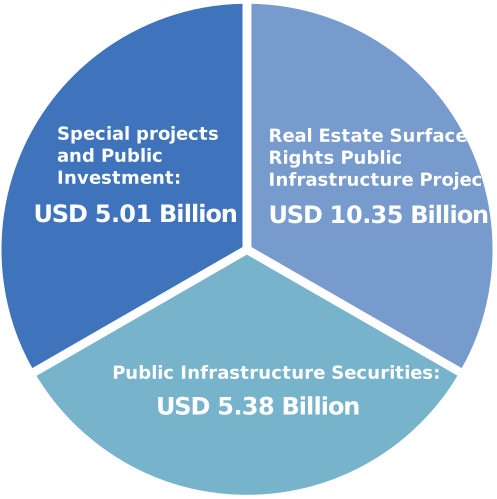
As of the second quarter of 2026, the total amount invested in special project investments in public and social welfare undertakings (including investments through land usufruct rights, securities, and other channels) is approximately 716 billion NTD, of which the amount applied under Article 146-5 of the Insurance Act is 196 billion NTD, accounting for 0.55% of the funds.
Promotional Measures
- Amend insurance regulations to expand the scope of domestic investments for insurance funds.
- Optimize risk coefficients for domestic investment targets to increase investment incentives.
- Adjust investment regulations based on the actual investment status and feedback from the insurance industry.
- Encourage indirect investment in domestic public infrastructure via Private Equity (PE) funds, Venture Capital (VC), or REITs.
Special projects
- Expand the Scope of Special projects and public Investments by Insurance Industry Funds (Interpretive orders issued on March 26, 2025):
- Expanded the scope of public investment by insurance fund including the public infrastructure developed pursuant to that is handled in accordance with the “Act for Promotion of Private Participation in Infrastructure Projects” and other laws and regulations.
- Expanded the scope of insurance industry investment in domestic private equity funds to include private participation in public infrastructure projects, ESG sustainable targets and social welfare enterprises.
- Allowed insurance companies to invest in and finance ESG sustainable targets. This includes enterprises whose primary economic activities meet the sustainability criteria defined in the “Taiwan Sustainable Taxonomy” as well as other targets identified by relevant authorities as providing benefits for climate adaptation, net-zero emissions, or sustainable transition.
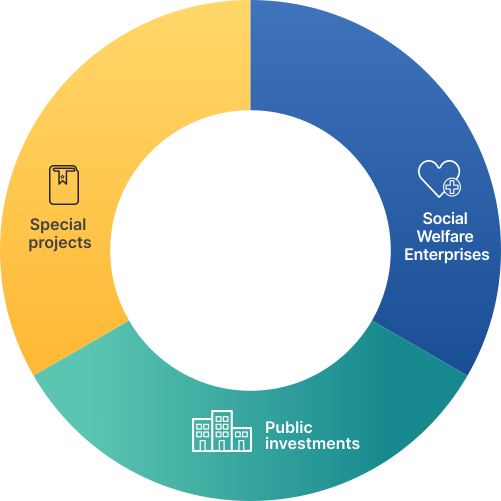
- On October 28, 2025, FSC has amended “Regulations Governing Use of Insurer's funds in Special Projects, Public Utilities and Social Welfare Enterprises“ to expand the scope of insurer’s funds:
- Increase the Investment Limit:Amend the investment limit applicable to insurance companies' investments in domestic private equity funds that have obtained a qualification letter pursuant to the National Development Council Directions for the Guidance and Administration of Private Equity Funds Investing in Industries. Specifically, the investment limit is increased from 20% to 25% of the total issued shares or paid-in capital of the investee, aligning it with the limit applicable to venture capital enterprises, thereby enhancing insurers' fund utilization efficiency and flexibility in asset allocation. (The interpretive order was promulgated on June 16, 2026.)
- Allow insurance companies to make investments in strategic industries under the AI New Top Ten Infrastructure Initiatives and other initiatives approved by the Executive Yuan, and ease the investment limit applicable to domestic private equity funds. (The interpretive order was promulgated on June 16, 2026.)
- Amended regulations to allow insurance companies to invest in and finance the “five trusted industries "(Interpretive orders issued on February 12, 2026)
Loans:
loans secured by real property made by insurance companies expanded to offshore wind power construction vessels (powered vessels with a gross tonnage of 20 tons or more, or non-powered vessels with a gross tonnage of 50 tons or more) as collateral. (Interpretive orders issued on October 15, 2025)
Insurance-related businesses:
adding the health and welfare businesses that are combined with insurance claims, underwriting, policyholder services or insurance product payments fall under the category of other insurance related businesses recognized by the competent authority as referred to in Article 146, Paragraph 4 of the Insurance Act. (Interpretive orders issued on October 27, 2025)
- Relaxed the rules for insurance companies investing 100% in public infrastructure either directly or through domestic private equity funds, venture capital enterprises and REIT, applying a risk factor of 1.28% during the investment period.
(Interpretive orders issued on September 12, 2024, December 13, 2024 and June 30, 2025) - Amended the 2025 "Scope and Formula for Calculating Total Adjusted Net Capital and Risk Based Capital of Insurance Companies" to optimize risk coefficients for domestic investment targets by insurance companies and increase investment incentives:
- Established a new risk coefficient of 10.18% for insurance industry investments in infrastructure.
- Adjusted the risk coefficient for investments in strategic industries and ESG sustainable targets (unlisted stocks) from 37.5% to 30%.
- Adjusted the risk coefficient for the industry-wide investment in Venture Capital (VC) within a total cap of NT$50 billion from 33.75% to 17.25%.
- Clarified define risk coefficients for investments in Private Equity (PE) and Venture Capital (VC):
- Government-approved infrastructure: 10.18%.
- Social welfare enterprises: 1.28%.
- Hybrid targets (Strategic industries, ESG sustainable targets, Public investment, Social welfare enterprises and Infrastructure): 17.25%.
- Stipulated that if an insurance company invests in public construction, social welfare, or infrastructure through domestic PE or VC funds, and such investments account for 80% or more of the fund’s total available capital (including insurance capital and other sources) a.k.a AUM, the risk coefficient for that specific category shall apply.
- Clarified regulations for capital lending within the investment frameworks of public investments by insurance companies. The procedures for lending and repayment of such funds are exempted from the "Regulations Governing Loaning of Funds and Making of Endorsements/Guarantees by Public Companies," thereby facilitating insurance industry participation in public works such as offshore wind power. (Interpretive orders issued on September 26, 2024)
- Amended “Regulations Governing Use of Insurer's funds in Special Projects, Public Utilities and Social Welfare Enterprises “on October 28,2025.The amendments include
- Increased the total amounts of special projects, public Investments and social welfare enterprises from 10% to 15% of insurer’s total funds, expecting to increase trillion NT dollars domestic investments.
- Expanded the scope of insurer’s funds to include the infrastructure approved by government.
- Increased the investment amounts that insurance companies can invest without going through the application procedure, simplifying administrative procedures, and expedite the investment process.
Infrastructure and public investments NT$ 500 million → 1 billion Invested entity regulated by the Act for PPP NT$ 1 billion → 2 billion Other invested entity NT$ 50 million → 100 million
- Expand the Scope:
Expanded the investment scope of private equity funds to include Public-Private Partnership (PPP) projects, infrastructure approved by government, social welfare enterprises, and ESG-related projects.
(Interpretive orders issued on October 28, 2025) - Optimize Risk Coefficient:
- Relaxed the rules for insurance companies investing 100% in public infrastructure either directly or through domestic private equity funds, venture capital enterprises and REIT, applying a risk factor of 1.28% during the investment period. (Interpretive orders issued on September 12, 2024, December 13, 2024 and June 30, 2025)
- Adjusted the risk coefficient for the industry-wide investment in Venture Capital (VC) within a total cap of NT$50 billion from 33.75% to 17.25%.
- Stipulated that if an insurance company invests in public construction, social welfare, or infrastructure through domestic PE or VC funds, and such investments account for 80% or more of the fund’s total available capital (including insurance capital and other sources, AUM), the risk coefficient for that specific category shall apply.
- Increase the Investment Limit:Amend the investment limit applicable to insurance companies' investments in domestic private equity funds that have obtained a qualification letter pursuant to the National Development Council Directions for the Guidance and Administration of Private Equity Funds Investing in Industries. Specifically, the investment limit is increased from 20% to 25% of the total issued shares or paid-in capital of the investee, aligning it with the limit applicable to venture capital enterprises, thereby enhancing insurers' fund utilization efficiency and flexibility in asset allocation. (The interpretive order was promulgated on June 16, 2026.)
- Other incentive measures: discussed adding venture capital and private equity awards to the incentive investment program.
Benefit
- Increased capital allocation channels for the insurance industry and encourage allocation toward stable-yield domestic targets to reduce the impact of financial market volatility and strengthen asset-liability management.
- Leveraged the long-term capital advantage of the insurance industry to assist the government in advancing public construction and revitalizing domestic capital markets. This aims to turn insurance capital into a key engine for economic transformation, enhancing national economic resilience and improving public well-being.